Mobile Notary Services: What to Know Before Signing Documents
American Health Biometrics Editorial Team — view author bio & areas of expertise →
Reviewed by the American Health Biometrics Compliance Team — Long Beach, CA — Live Scan, notary & apostille operations
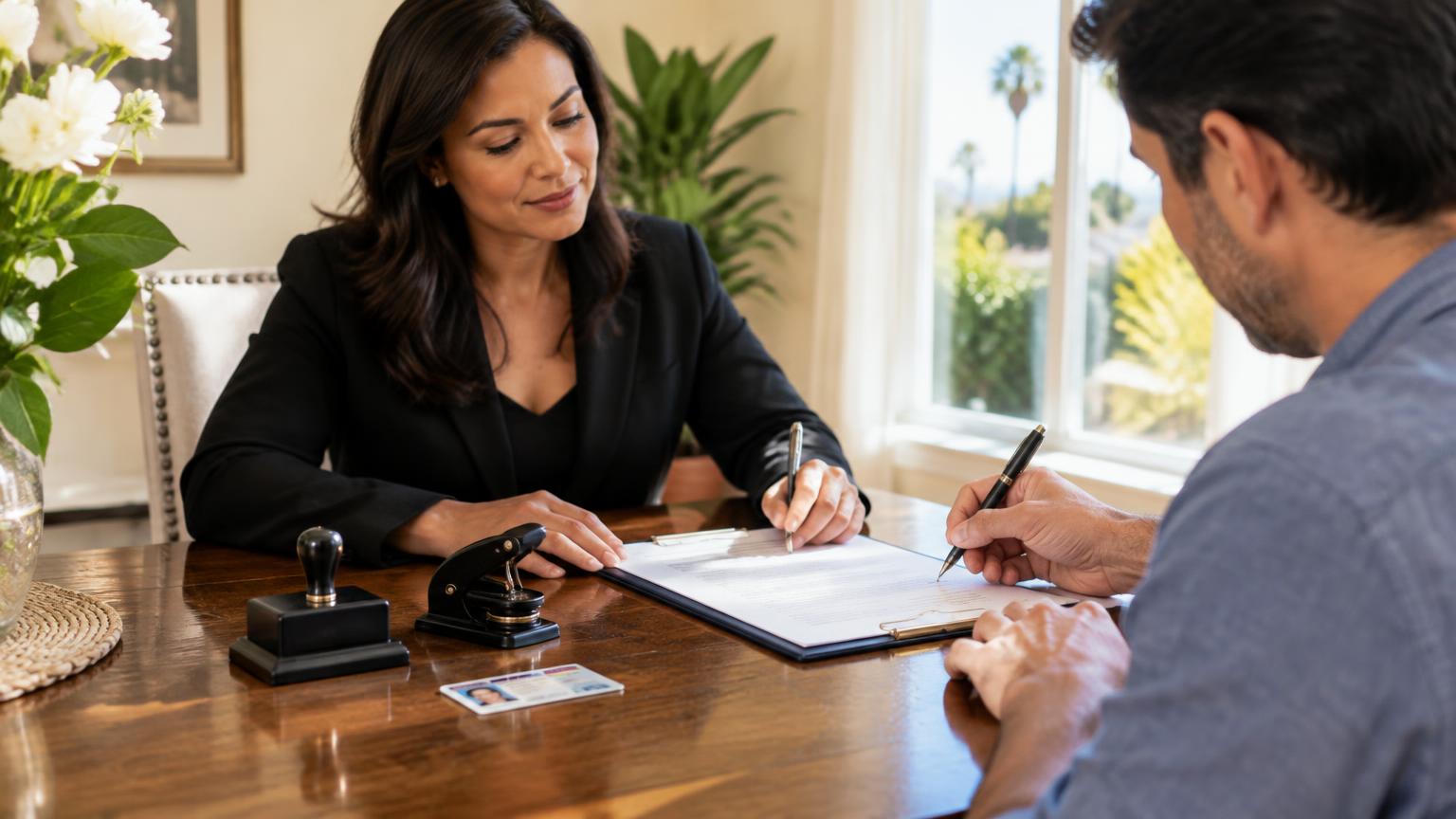
Important documents often need more than a signature to be accepted. Depending on the document and its purpose, you may need a notary public to verify your identity and witness the signing process.
Mobile notary services can be useful for people who need notarization away from a traditional office, but it is important to understand what these services involve before making arrangements. Knowing which documents require notarization, what identification to bring, and how to prepare for an appointment can help you complete the process with fewer delays.
What Are Mobile Notary Services?
Mobile notary services involve a notary public travelling to an agreed location to perform an eligible notarial act. Instead of visiting a notary's office, a signer may arrange to meet the notary at a suitable location, depending on the service provider's availability and requirements.
A notary public acts as an impartial witness during the signing of important documents. The notary verifies the identity of the signer and helps ensure that the document is signed according to the applicable requirements.
These services may be useful when someone has difficulty travelling to an office or needs notarization at a particular location. However, the availability of mobile appointments depends on the provider, location, and type of document involved.
Before arranging a visit, confirm whether the notary can handle your document and whether the service is available at your preferred location.
Which Documents May Require Notarization?
Notarization is commonly used for documents involving legal, financial, property, and personal matters. The exact requirements depend on the document and the organization requesting it.
Common examples include:
- Real estate documents: Deed transfers, mortgage paperwork, and property closing documents may require notarization.
- Legal documents: Affidavits, sworn statements, and certain court-related documents may need a notary.
- Financial documents: Loan paperwork, trust documents, and banking forms may require notarization.
- Estate planning documents: Certain powers of attorney, wills, and trust-related documents may involve notarization.
- Business documents: Contracts, partnership agreements, and corporate filings may require notarized signatures.
- Personal documents: Consent forms, travel authorizations, and other documents may need notarization, depending on their purpose.
Not every document in these categories automatically requires notarization. Check the instructions provided by the receiving organization before scheduling an appointment.
How Does the Notarization Process Work?
The notarization process involves checking the signer's identity and completing the required notarial act. Preparing beforehand can make the appointment easier to manage.
Although the exact steps vary by document, the process generally includes the following:
- Confirm the requirements: Find out whether the document needs an acknowledgment, jurat, or another permitted notarial act.
- Prepare the document: Bring the correct document and follow any instructions about when to sign it.
- Present acceptable identification: The notary must establish your identity using identification that meets the applicable requirements.
- Complete the required signing process: The notary performs the appropriate act after the necessary conditions are met.
- Check the completed document: Review the document for missing information and confirm that all required sections have been completed.
Do not assume that a notary can advise you on which legal terms to use or determine whether a document meets every requirement of the organization receiving it. Confirm those details with the appropriate professional or organization beforehand.
What Should You Prepare Before an Appointment?
Preparation helps prevent avoidable problems, especially when a document has specific signing or identification requirements.
Before your appointment, consider the following checklist:
- Valid identification: Bring a government-issued photo ID that meets the applicable identification rules.
- Complete paperwork: Make sure you have the correct document and any required supporting forms.
- Signing instructions: Check whether you should sign the document in front of the notary rather than beforehand.
- Receiving organization requirements: Review any special instructions provided by the court, financial institution, employer, or other recipient.
- Appointment details: Confirm the location, time, availability, and any applicable fees before travelling or arranging a visit.
California identification requirements may allow certain forms of identification beyond a standard government-issued photo ID. However, not every form of identification qualifies, so confirm that your identification is acceptable before the appointment.
Mobile Notary Services vs. Office-Based Notarization
Both options involve a notary performing an eligible notarial act, but the appointment arrangements can differ. The right choice depends on your location, schedule, and the services available from the provider.
| Factor | Mobile notarization | Office-based notarization |
|---|---|---|
| Appointment location | An agreed location outside the notary's office | The notary's designated office |
| Travel arrangements | The notary may travel to the signer | The signer generally travels to the office |
| Scheduling | Depends on travel availability and appointment arrangements | Depends on office hours and appointment availability |
| Additional costs | Travel or other service fees may apply | Fees depend on the provider and service |
| Preparation | Confirm the meeting location and document requirements | Confirm office details and document requirements |
The table describes general differences rather than guaranteed features of every provider. Always check the actual service arrangements and charges before making a decision.
When Might a Mobile Appointment Be Useful?
A mobile appointment may be worth considering when visiting an office is inconvenient or when the people involved need to coordinate signing at a particular location.
Some situations where this arrangement may help include:
- Limited travel options: A person may find it difficult to travel to a notary's office because of personal or practical constraints.
- Busy schedules: Arranging a suitable meeting location may help people coordinate around work and other responsibilities.
- Multiple signers: When several people need to sign documents, a suitable appointment arrangement may make coordination easier.
- Property-related paperwork: Parties involved in property transactions may need to organize signing around other appointments.
- Business documentation: Some businesses may prefer to explore location-based arrangements when documents need to be signed outside regular office routines.
These are potential reasons to consider a mobile appointment, not a guarantee that every provider offers each arrangement. Availability, travel distance, document requirements, and applicable rules should be confirmed first.
What Types of Notarial Acts Are Available?
The type of notarization required depends on the document and the instructions provided by the receiving organization. Understanding the difference between common notarial acts can help you ask the right questions before scheduling.
- Acknowledgments: These involve a signer acknowledging that they signed a document. The notary verifies the signer's identity and completes the required acknowledgment procedure.
- Jurats: These involve the signer swearing to or affirming the truthfulness of a statement and signing according to the applicable procedure.
- Power of attorney notarization: Certain power of attorney documents require notarization, depending on the applicable rules and circumstances.
- Loan document signing: Some loan documents require notarization as part of the signing process.
- Affidavits and sworn statements: These documents may require a jurat or another appropriate notarial act.
A notary's role is limited to the duties permitted by applicable law. The notary does not automatically verify that every statement in a document is factually correct or that the document provides the legal outcome you want.
How to Check a Notary Provider Before Booking
Before booking mobile notary services, take time to confirm the details that matter for your document and situation. This is especially important when paperwork has a deadline or must meet specific legal requirements.
Ask the provider these questions:
- Do you handle the type of document I need notarized?
- Can you travel to my preferred location?
- What identification and supporting paperwork should I bring?
- Is an appointment required, and what times are available?
- Are travel charges or other fees added to the notarization fee?
- Can the required notarial act be completed under the applicable state rules?
Clear answers can help you understand what to expect and avoid arranging an appointment that does not meet your needs.
Understanding Notary Services at American Health Biometrics
American Health Biometrics provides notary public services in Long Beach, California, alongside its Live Scan fingerprinting services. According to its published service information, the notary service covers acknowledgments and jurats, loan document signing, power of attorney notarization, affidavits and sworn statements, and real estate and title documents.
The company states that its commissioned notary public is available during business hours. When notarization is combined with fingerprinting services, a separate notary appointment is not required, although customers should confirm the arrangements and availability for both services.
The listed location is 3816 Stineman Ct, Suite 104, Long Beach, CA 90808. Business hours are Monday through Friday, 9 a.m. to 7 p.m., with the office closed on weekends.
Conclusion
Notarizing a document can be straightforward when you understand the requirements and prepare the necessary paperwork in advance. Mobile notary services may offer a practical alternative for people who need a notary to travel to an agreed location, but availability, fees, identification rules, and document requirements vary.
Before booking, confirm the type of notarization you need and check whether the provider can accommodate your location. American Health Biometrics offers notary services alongside fingerprinting in Long Beach, California, and can be contacted directly or reached at (562) 420-4692 for details about its available appointment arrangements.
FAQs
What ID do I need for a mobile notary appointment?
Bring a current government-issued photo ID that meets California identification rules, such as a driver's license, state ID, or passport. Confirm your ID is acceptable before the appointment.
Should I sign my document before the notary arrives?
Not always. Many documents, especially those requiring a jurat, must be signed in front of the notary. Check the document's instructions and wait if you are unsure.
Can a notary give legal advice about my document?
No. A notary verifies identity and performs the notarial act. Questions about legal wording or whether a document meets a recipient's requirements should go to an attorney or the receiving organization.
Do I need a separate notary appointment if I'm getting fingerprinted?
At American Health Biometrics, notarization can be combined with fingerprinting without a separate notary appointment. Confirm availability for both services when you book.
Sources & References
This article is for general information. Fingerprinting, notary, and apostille requirements are set by the requesting agency and can change — always follow the instructions provided by the agency requesting your documents.
Certified Live Scan provider submitting electronically to the California DOJ and FBI.
Fingerprint submissions are transmitted securely — we do not store your biometric data.
Serving Long Beach, Lakewood, Signal Hill, Cerritos, Carson and the greater Los Angeles area.
Rated by verified Google reviewers — see why clients choose us.
About American Health Biometrics
American Health Biometrics is a Long Beach, California provider of Live Scan fingerprinting, ink card fingerprinting, notary, and apostille services. We help applicants and employers complete California DOJ and FBI background check requirements in-office at 3816 Stineman Court Suite 104, or on-site through our mobile Live Scan service. Questions about your appointment? Call (562) 420-4692 or contact us.