Skip to content
 Need to complete a background check for another state while you live, work, or study somewhere else?
That situation comes up more often than most applicants expect. A nursing candidate moves to a new role. A teacher applies for a license in another state. A contractor takes remote work tied to a different jurisdiction. In each case, the agency wants fingerprints in a format it can receive, review, and file under its own rules. That is where the ink card fingerprint mobile becomes useful. It gives you a path that travels well across state lines, fits manual submission rules, and works for agencies that want fingerprint cards instead of a local electronic scan.
For out-of-state screening, the goal is not just to submit prints. The goal is to submit the right prints, on the right card, with the right identifiers, for the right agency. When that happens, your application moves with less friction and stronger alignment from start to finish.
The Role of Ink Card Fingerprint Mobile in Cross-State Verification
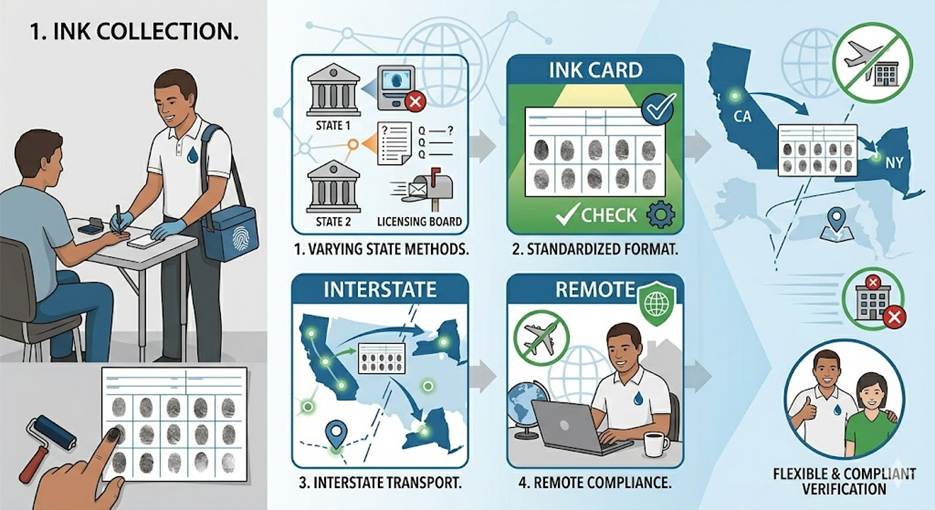
Cross-state verification depends on standardisation. States, licensing boards, employers, and federal agencies do not all use the same intake method. Many still process manual fingerprint cards for applicants who live outside their service region or who file through national review channels.
That makes ink card fingerprinting more than a fallback option. It becomes a transportable format for identity verification. A properly completed card can move from one state to another without forcing the applicant to appear in person at the receiving agency’s office. For remote workers, interstate hires, and people in licensed professions, that flexibility helps keep the screening process aligned with agency instructions.
Accepted Method for Agencies That Do Not Support Live Scan
Some agencies still ask for manual fingerprint cards because their process begins with a mailed packet, an attached authorization form, or a board-issued instruction sheet. In those cases, the ink card fingerprint mobile gives applicants a service model that matches the agency’s intake path.
This is where good technique counts. Finger ridge detail, card placement, demographic fields, signature blocks, and agency identifiers all need attention. A card that looks clean, reads well, and matches the agency packet supports smoother processing.
Helps Meet FBI FD-258 Submission Requirements
The FBI FD-258 card remains a common format for background screening tied to federal review, licensing, immigration-related paperwork, regulated employment, and interstate verification. Agencies use it because it creates a consistent layout for identity data and fingerprint impressions.
A complete FD-258 card includes more than rolled and flat prints. It also includes the applicant’s identifying details, the purpose for fingerprinting, the right routing data, and the technician’s completion steps where required. When a trained provider fills out those elements with care, the card becomes easier for the receiving agency to process.
Supports Licensing, Employment, and Compliance Needs Across States
Out-of-state checks often serve different end goals. One applicant needs a board license. Another needs employer screening. Another needs compliance clearance for a regulated assignment. Ink cards work across those categories because they follow a recognised submission format.
| Use Case | Why Ink Cards Fit Out-of-State Review |
| Professional licensing | Boards can receive a standard card with applicant and agency details |
| Employment screening | Employers can route cards through approved background review channels |
| Compliance programs | Manual cards support file-based clearance workflows across jurisdictions |
| Remote hiring | Applicants can complete prints where they live and submit them where they apply |
This format helps agencies review comparable records across state lines without forcing each applicant into one local system.
Simplifies Documentation for Applicants Relocating or Working Remotely
Relocation changes timelines. Remote work changes logistics. Applications often move faster than travel plans. In that kind of workflow, an ink card fingerprint mobile helps because it brings the service to the applicant rather than tying the process to one office visit in one market.
That convenience serves people who need fingerprints for a job offer, hospital credentialing, education placement, contractor onboarding, or a multi-state license packet. Instead of building the rest of the application around one location-bound task, the applicant can complete the fingerprinting step in a format that fits the destination state’s paperwork. That keeps the submission package organised and easier to manage.
Ensures Standardised Record Processing Across Jurisdictions
Agencies value uniform input. When fingerprint cards follow a recognised structure, reviewers can process them within an established workflow. That is one reason fingerprinting remains central in regulated screening. In fact, fingerprint recognition held 35% market share in banking and financial services biometrics during 2025. That figure points to continued trust in fingerprint-based identity systems where audit trails and record integrity carry weight.
For interstate verification, standardised cards support that same principle. They present applicant data in a format agencies already know how to review. That consistency helps licensing boards, employers, and compliance teams handle submissions from different states without changing their internal process for each applicant.
Reduces Delays Caused by Incomplete or Rejected Submissions
Out-of-state packets move through several hands. That makes complete documentation a strong advantage. Clean prints, legible text, correct card type, and proper technician completion all help the receiving agency move the file forward.
This is where the ink card fingerprint mobile serves more than convenience. It supports submission quality. A trained technician can confirm the right card, check impression quality, and verify that the demographic and routing fields line up with the applicant’s packet. That kind of preparation helps keep timing on track for job starts, board reviews, and compliance deadlines.
Why Many Applicants Choose Ink Card Fingerprint Mobile Through American Health Bio Services
American Health Bio connects manual fingerprint card service with on-site convenience. That combination works well for people who need out-of-state submissions, FD-258 cards, and mobile scheduling through one provider.
At American Health Bio, we handle both Live Scan and Ink Card Fingerprinting, which saves applicants from coordinating with multiple vendors. We also support public applicants, businesses, and group requests with a service model that fits both office visits and on-site appointments.
Key reasons applicants choose this route include:
- DOJ and FBI-certified technicians who complete signed FBI cards with certification details where required
- Support for FBI FD-258 cards and out-of-state submissions across licensing, hiring, and compliance use cases
- Mobile fingerprinting for organisations, executive schedules, and group bookings of 8 or more
- The option to provide fingerprint cards when the applicant does not already have them
We also bring mobile fingerprinting to client locations, which helps teams complete screening steps without breaking the workday.
Steps to Complete an Ink Card Fingerprinting Process for Out-of-State Use
The process works best when you treat fingerprinting as part of the application packet, not a separate errand. Start by reviewing the agency’s instructions. Check the card type, mailing address, reason for fingerprinting, photo ID rules, and whether the agency wants an ORI, account code, or board form attached.
Next, book an appointment with a provider who handles out-of-state fingerprint cards and FD-258 submissions. Bring the agency paperwork, valid identification, and any prefilled forms you received. During the appointment, the technician captures rolled and flat prints, reviews the card fields, and completes the required technician information.
After that, review the card packet before mailing or handoff. Confirm names, dates, signatures, and routing details. If the agency requires multiple cards, include them in the same packet. At American Health Bio, we help applicants line up the card format with the destination requirement so the full submission package stays organised from appointment to dispatch.
Conclusion
Out-of-state background checks work best when your fingerprint format matches the receiving agency’s process from the start. That is why ink card fingerprint mobile remains a strong choice for applicants who need portability, FD-258 support, mobile access, and clean documentation across state lines.
If your next application involves licensing, employment, relocation, or interstate compliance review, choose a provider that can align the fingerprinting step with the full packet. Book your appointment with American Health Bio and keep your submission moving with a service built for out-of-state screening.
FAQs
Some agencies allow that, but many ask for a separate original card for each file.
Bring a valid government-issued photo ID that matches the name on your application forms.
Yes. Many teams schedule on-site sessions for staff onboarding, compliance reviews, and group clearances.
Not always. Many providers can supply the card when your agency accepts a standard FBI format.
Most individual appointments move fast once your paperwork and ID are ready.